Panto vs Other Frame Shapes: What Actually Works (And Why Most Designs Don’t)
When choosing glasses, most people are presented with a wide range of frame shapes.
You will typically see options like:
- round
- square
- rectangular
- oval
- oversized
- geometric
Each of these shapes has its own visual identity.
But what is often missing is a deeper understanding of how these shapes actually work on the face.
Because not all frame shapes are designed in the same way.
And not all of them are equally effective.
(See also Which glasses suit your face shape)
WHY FRAME SHAPE MATTERS MORE THAN YOU THINK
At first glance, frame shape seems like a matter of personal taste.
And to some extent, it is.
But shape also determines:
- how the frame interacts with your facial structure
- how balanced or unbalanced it appears
- how comfortable it feels over time
A frame that looks appealing on its own can behave very differently when worn.
This is where the difference between design philosophies becomes important.
TWO FUNDAMENTAL APPROACHES TO FRAME DESIGN
Most frame shapes fall into one of two categories:
- Expression-driven design
These shapes are created to make a statement.
Examples:
- strong square frames
- sharp geometric designs
- oversized styles
They are visually distinctive — but often less adaptable.
- Balance-driven design
These shapes are created to work with the face.
They focus on:
- proportion
- harmony
- long-term wearability
Panto belongs to this category.
(See What are Panto glasses)
HOW COMMON FRAME SHAPES BEHAVE
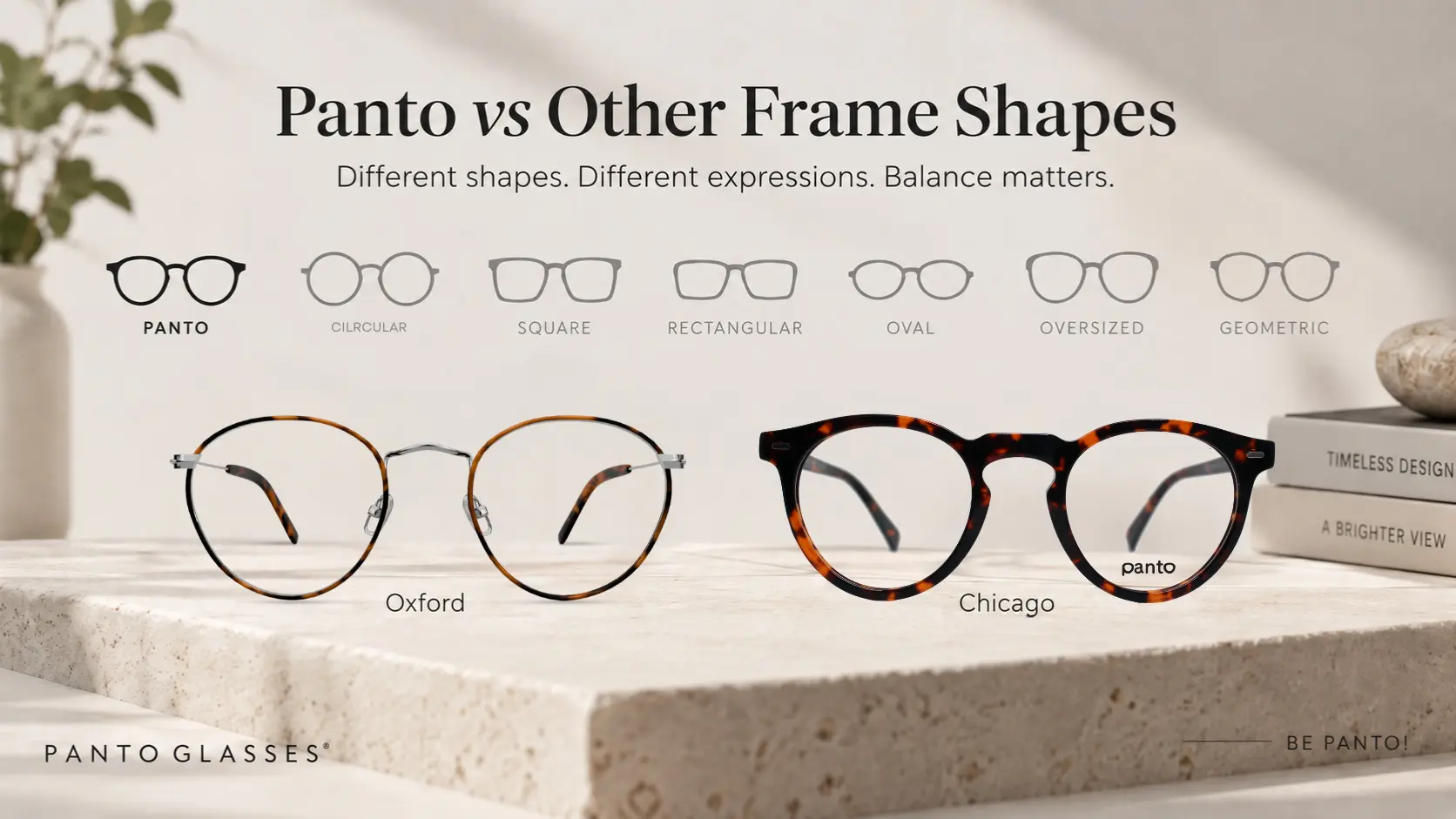
To understand why Panto stands out, it helps to compare it with other common shapes.
ROUND FRAMES
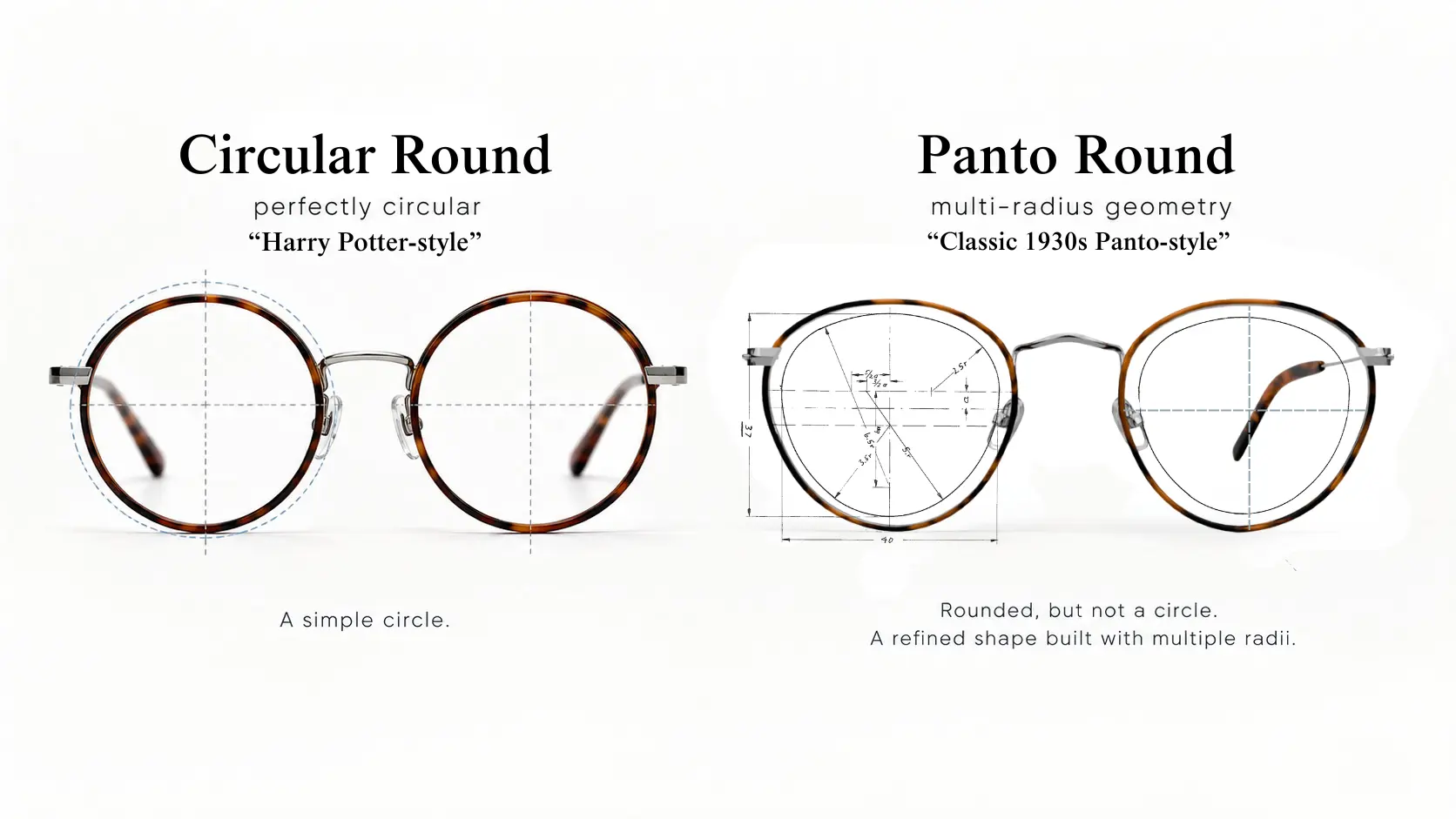
Round frames are based on a perfect circle.
They:
- emphasize softness
- create a strong visual identity
- can exaggerate facial roundness
They work well for certain styles, but are less forgiving.
(See Round vs Panto glasses)
SQUARE AND RECTANGULAR FRAMES
These shapes introduce strong angles.
They:
- add structure
- emphasize sharp features
- create contrast
This can be effective, but also:
- visually aggressive
- less adaptable across face types
OVAL FRAMES
Oval shapes are softer than round frames.
They:
- reduce sharpness
- feel more neutral
However, they can sometimes lack definition and appear visually weak.
OVERSIZED FRAMES
Oversized designs focus on scale rather than shape.
They:
- draw attention
- create presence
But they can also:
- overwhelm facial features
- become tiring over time
GEOMETRIC AND TREND-DRIVEN SHAPES
These include hexagonal, angular, or unconventional designs.
They are:
- highly expressive
- trend-driven
But often:
- short-lived
- less practical for daily use
WHAT MAKES PANTO DIFFERENT
Unlike the shapes above, Panto is not built around a single visual idea.
It is built around balance.
A true Panto shape is:
- slightly flatter at the top
- more rounded at the bottom
- proportionally controlled
This creates a form that:
👉 adapts to the face instead of dominating it
(See Why Panto glasses fit most face shapes)
WHY BALANCE OUTPERFORMS EXTREMES
Extreme shapes can be effective in specific contexts.
But they come with limitations.
A frame that is:
- too angular
- too round
- too large
will often:
- suit fewer people
- feel less natural
- become less comfortable over time
Balanced designs avoid these problems.
They work more consistently.
EVERYDAY USE VS OCCASIONAL STYLE
This is where the difference becomes clear.
Statement frames:
- are ideal for specific looks
- work well in controlled settings
Balanced frames:
- work across different situations
- remain comfortable over long periods
- require less adjustment
For most people, everyday usability matters more than short-term impact.
(See Best glasses for everyday use)
WHY PANTO HAS REMAINED RELEVANT
The reason Panto glasses have been used for nearly 100 years is not because of fashion.
It is because they work.
Their design is based on:
- human facial structure
- visual balance
- practical use
While trends come and go, these principles remain constant.
(See The history of Panto glasses)
CHOOSING THE RIGHT FRAME FOR YOU
Instead of asking:
“What shape is most popular?”
A better question is:
“What shape will work for me every day?”
Consider:
- how the frame feels on your face
- how it interacts with your features
- how it performs over time
In many cases, a balanced design will outperform a more expressive one.
FINAL THOUGHT
Most frame shapes are designed to express something.
Panto is designed to function.
That is why it does not rely on trends.
It relies on balance.
And in eyewear, balance is what makes a frame not just wearable…
👉 but reliable.
FAQs
How do Panto glasses compare to other frame shapes?
They are more balanced and adaptable, making them suitable for more people and situations.
Are square or rectangular frames better than Panto?
They can be effective, but are more extreme and less versatile.
Do oversized glasses work for everyday use?
They can, but are often less comfortable and less adaptable over time.
Why is Panto considered a classic shape?
Because it is based on balance and function, not trends.
Explore everyday-ready designs here:


Written by 4th generation Optician Geir Sivertzen, PantoGlasses AS, Norway.
On This Page
Share:
You May Also Like